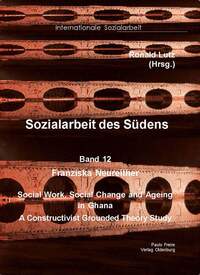
Growing old in Ghana, within the safety of the family, was once taken for granted; yet the dynamics of social change are increasingly challenging this notion. This study examines how these dynamics influence the lived experiences of older adults. It focuses on how historically evolved global power structures reshape cohabitation and traditional support systems in contemporary Ghana. This also raises questions about the ambiguity of social work within this nexus. Following a constructivist grounded theory approach, incorporating elements of situational analysis, the study began as an exploratory inquiry. Through an inductive-abductive process, a case study in a rural community in the Ashanti Region became a focal side of the research. The empirical data are analysed through a critical lens, considering historical dynamics, and linking the data to Karl Polanyi’s thoughts on economics. The findings reveal global power dynamics that create complex contradictions, that pose significant long-term challenges on growing old. Social work is called upon to critically examine its own colonial entangled history and current realities, while pursuing decolonised pathways. The study concludes by linking traditional artefacts, particularly adinkra symbols, to social work with older adults and beyond.